Let’s have a look at the history behind Porsche Designs Timepieces and what the opening of the new manufaktur might mean for the future of this sub-division of the legendary Porsche Auto Group.
The Orfina Era (1972–1978): Forging the Black Chronograph
- Chronograph 1
- Military 3H Editions
- Integrated Bracelets
The genesis of Porsche Design Timepieces is inextricably linked to the automotive world, yet it was born from an independent creative vision. In 1963, Ferdinand Alexander “Butzi” Porsche, the grandson of the automaker’s founder, penned one of the most enduring and recognizable industrial designs of the twentieth century: the Porsche 911. However, shifting corporate dynamics in the early 1970s dictated that members of the Porsche family step away from the automaker’s day-to-day management. Seeking a new canvas for his Bauhaus-inspired, highly utilitarian design sensibilities, F.A. Porsche established the independent Porsche Design Studio in Stuttgart, Germany, in 1972.
This rigorous ethos materialized in 1972 with the studio’s inaugural product: the Chronograph 1. Initially commissioned by Porsche AG as a commemorative gift for long-standing employees, the timepiece inadvertently revolutionized the global watch industry by becoming the first commercially available wristwatch to feature an entirely black aesthetic. The logic behind this radical design departure was deeply practical rather than stylistic. Drawing direct inspiration from the matte-black, anti-glare instrument clusters of contemporary racing cars and aircraft, F.A. Porsche sought to eliminate distracting light reflections that could impede readability during high-speed operation.
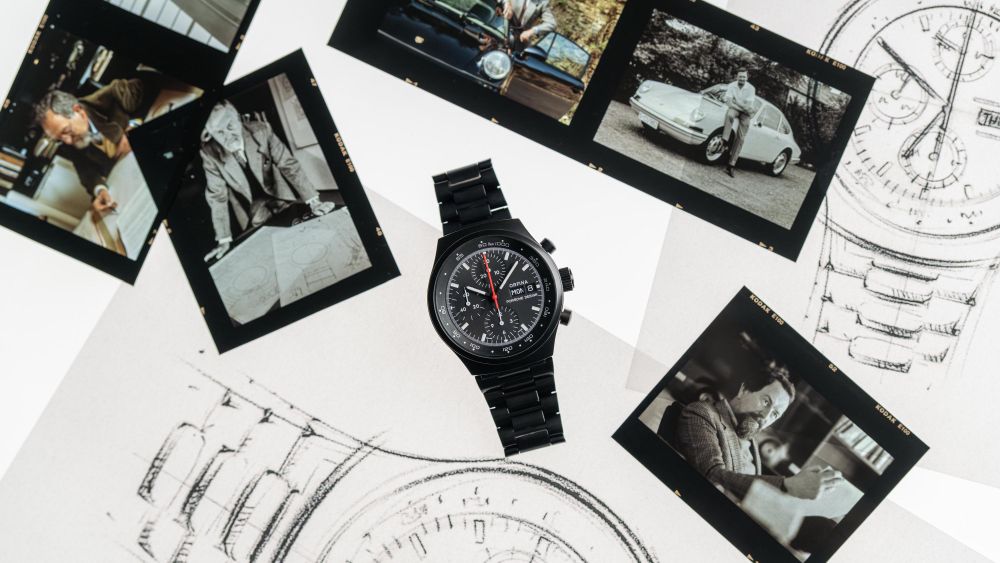
The stark white luminescent numerals and hands, coupled with a distinct red central chronograph seconds hand that mirrored the 911’s tachometer needle, provided unparalleled legibility under all lighting conditions. The Chronograph 1 was not merely a watch styled to resemble a car; it was a watch engineered from the ground up with the unyielding mindset of an automotive designer.
To realize his vision for the Chronograph 1, F.A. Porsche partnered with Orfina, an established watchmaker based in Grenchen, Switzerland. Early iterations of the Chronograph 1 utilized the newly introduced Valjoux 7750, a robust, cam-actuated automatic chronograph caliber that would soon become the dominant backbone of the Swiss mechanical chronograph industry. The watch featured a stainless steel case and an integrated bracelet, both treated with a hard black Physical Vapor Deposition (PVD) coating to achieve the desired matte, anti-glare finish.
The IWC Era (1978–1998): Titanium Mastery and Deep Ocean Exploration
- Compass Watch
- Titan Chronograph
- Ocean 2000 / Ocean 500
In 1978, driven by a relentless desire to push the boundaries of material science, Porsche Design ended its initial partnership with Orfina and forged a historic, multi-decade alliance with the International Watch Company (IWC) in Schaffhausen. This collaboration, orchestrated alongside the visionary horological executive Günter Blümlein, proved to be one of the most fruitful and significant in modern watchmaking history. It is widely acknowledged that the influx of innovative design and commercial success from the Porsche Design partnership was instrumental in saving IWC from bankruptcy during the darkest years of the Quartz Crisis.
The IWC era was characterized by groundbreaking engineering and the introduction of exotic materials into the conservative realm of horology. The first product of this union was the highly unconventional Compass Watch, released in 1978. Conceived by F.A. Porsche for the avid outdoorsman, it featured a complex, two-part hinged case made entirely of lightweight, anti-magnetic aluminum. The upper mechanical watch module could be flipped open via a rear hinge to reveal a liquid-filled compass nestled beneath, engineered meticulously so that the watch’s internal metallic components would not magnetically interfere with the compass needle.
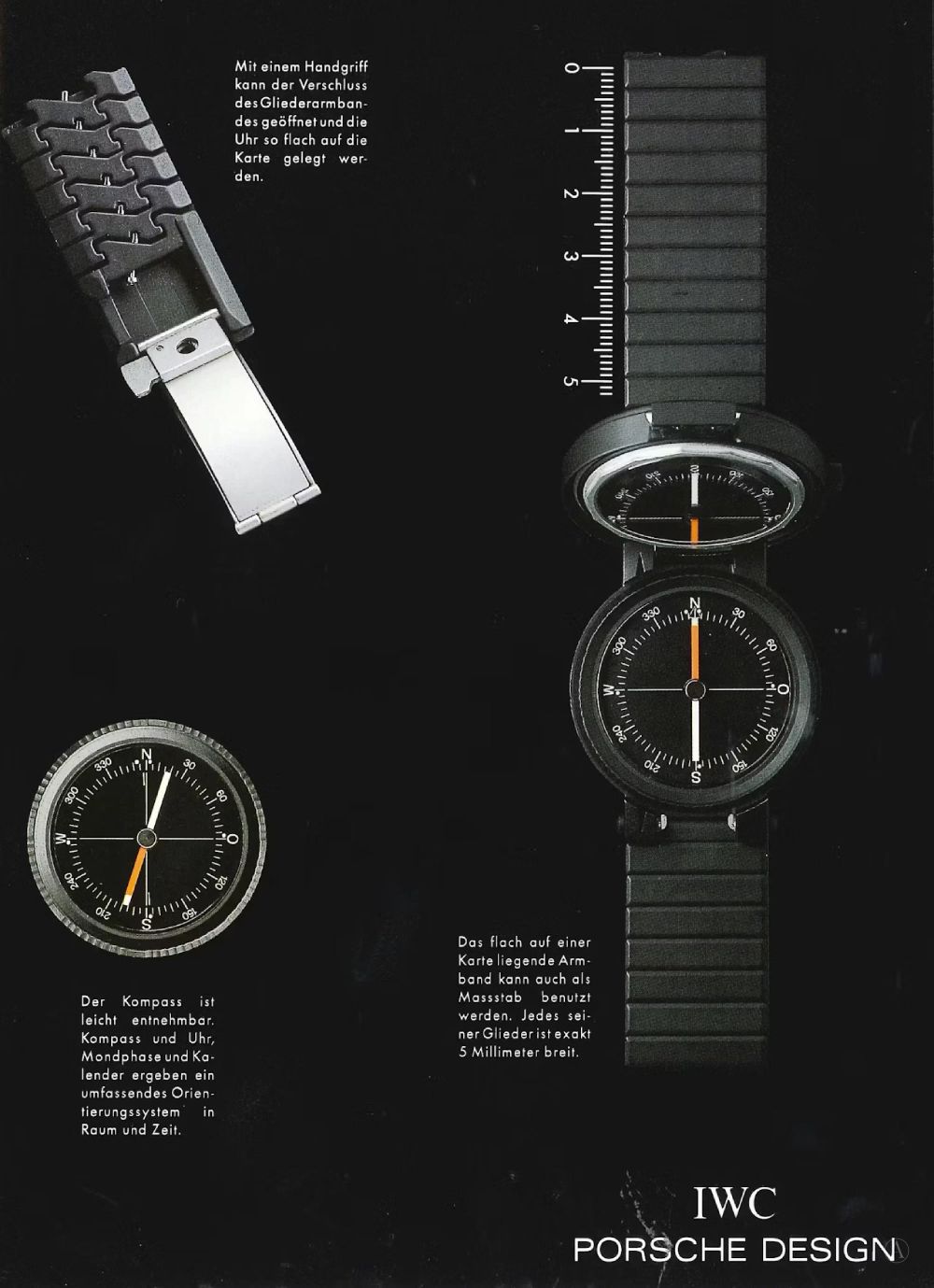
However, the crowning achievement of the Porsche Design and IWC partnership was the absolute mastery of titanium. In 1980, the duo unveiled the Titan Chronograph (originally Reference 3700), universally recognized as the world’s first production wristwatch featuring both a titanium case and a fully integrated titanium bracelet. At the time, titanium was an exotic, highly expensive metal utilized almost exclusively in the advanced aerospace sector; it was notoriously difficult to machine due to its extreme hardness and tendency to combust during the milling process. IWC was forced to develop entirely new tooling and proprietary production methods to manipulate the refractory metal into the sleek, aerodynamic lines demanded by F.A.Porsche. This included flush chronograph pushers that were seamlessly integrated into the contours of the case flanks, preserving the unbroken visual flow of the object.
This unparalleled expertise in titanium machining directly led to the development of the Ocean 2000 in 1982. Commissioned initially for the West German Navy’s elite combat swimmers (Kampfschwimmer), this futuristic dive watch achieved a staggering water resistance of 2,000 meters—an absolute record for a civilian production watch at the time—and accomplished this feat without the need for a bulky helium escape valve. The military contracts yielded highly specialized and collectible variations, including the profoundly rare Reference 3519 AMAG.
This completely anti-magnetic mechanical watch was designed specifically for mine-clearance divers, utilizing a beryllium balance and non-magnetic movement components to comply with the rigorous NATO STANAG 2897 standards for magnetic behavior. A smaller variant, the Ocean 500, was also produced, offering a 500-meter depth rating in a more compact profile.
The Eterna Era (1995–2014)
- P'6910 Indicator
- Flat Six Collection
- P'6780 Diver
By the mid-1990s, the highly successful partnership with IWC reached its natural conclusion. Günter Blümlein had repositioned IWC alongside A. Lange & Söhne and Jaeger-LeCoultre under the prestigious umbrella of the Richemont Group, while the Porsche family sought tighter, vertical control over their horological output. In 1995, executing a bold strategic maneuver, F.A. Porsche acquired the historic Swiss watch manufacturer Eterna, headquartered in Grenchen, ensuring a dedicated, in-house production facility for Porsche Design timepieces.
The Eterna era produced several notable horological achievements that further blurred the lines between watchmaking and automotive engineering. The most dramatic and ambitious was the P'6910 Indicator, introduced in 2004. This massive titanium timepiece was the world’s first mechanical chronograph to display elapsed hours and minutes digitally via jumping numerals, mimicking the mechanical odometers of classic sports cars. The highly complex movement consisted of over 800 individual components, requiring a separate gear train and mainspring barrel simply to power the energy-intensive digital display.
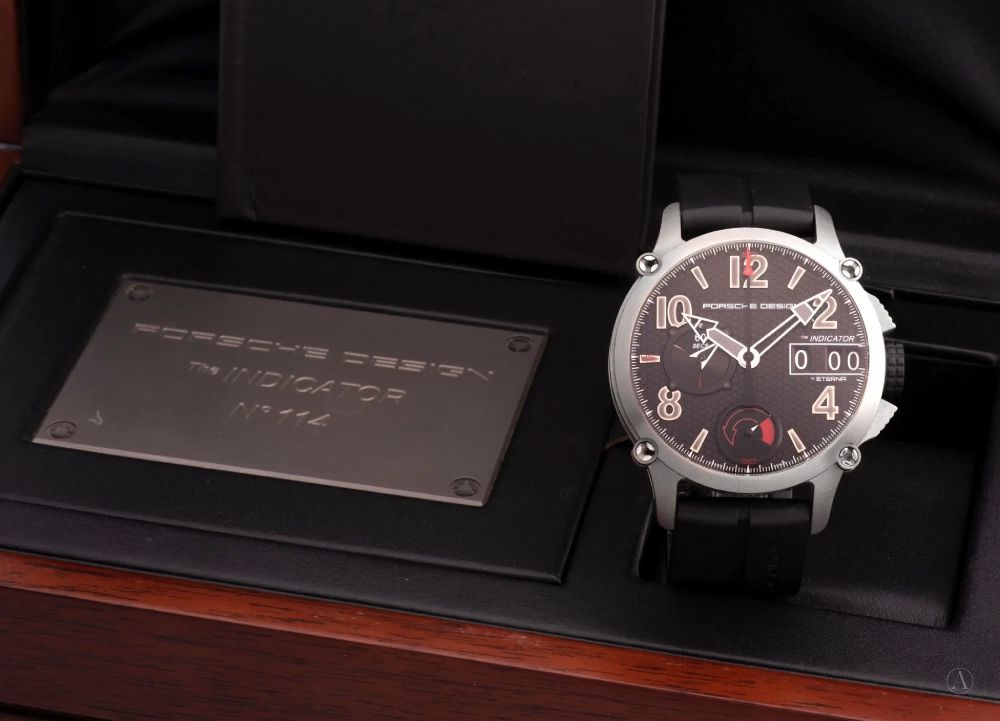
Retailing for well over €100,000, it served as a formidable halo product for the brand. Other significant models from this era included the P'6780 Diver, which featured a complex hinged case design paying homage to Eterna’s KonTiki heritage, and the Flat Six collection, which directly referenced the boxer engines of the Porsche 911.
However, the Eterna era was also marked by challenges and a perceived dilution of the brand’s purist philosophy. Following F.A. Porsche’s retirement from active design duties in 2005, the aesthetic direction temporarily lost its uncompromising, functional edge, drifting toward more generic luxury styling. In 2012, following the passing of F.A. Porsche, the family made the strategic decision to sell Eterna to the Chinese Haidian Group (now Citychamp Watch & Jewellery Group). This sale severed the brand’s direct manufacturing arm, necessitating a fundamental restructuring of Porsche Design’s watchmaking strategy and acting as the catalyst for the move toward true, unassailable independence.
Porsche Design Timepieces AG Solothurn (2014–2026)
Recognizing the strategic necessity of total vertical integration in the modern luxury watch market, the Porsche Design Group established Porsche Design Timepieces AG as a wholly owned subsidiary in Solothurn, Switzerland, in 2014. This pivotal move marked the first time the brand took absolute control over the development, design, and assembly of its watches, effectively transforming from a design studio that licensed its name into a fully-fledged, independent watchmaker.
This newfound independence necessitated the development of proprietary mechanical movements to replace the off-the-shelf ETA ebauches utilized during the Eterna era. The result was the introduction of the sophisticated WERK calibers, beginning with the flyback chronograph caliber WERK 01.200 in 2017, featured prominently in the Chronotimer Turbo S Exclusive Series.
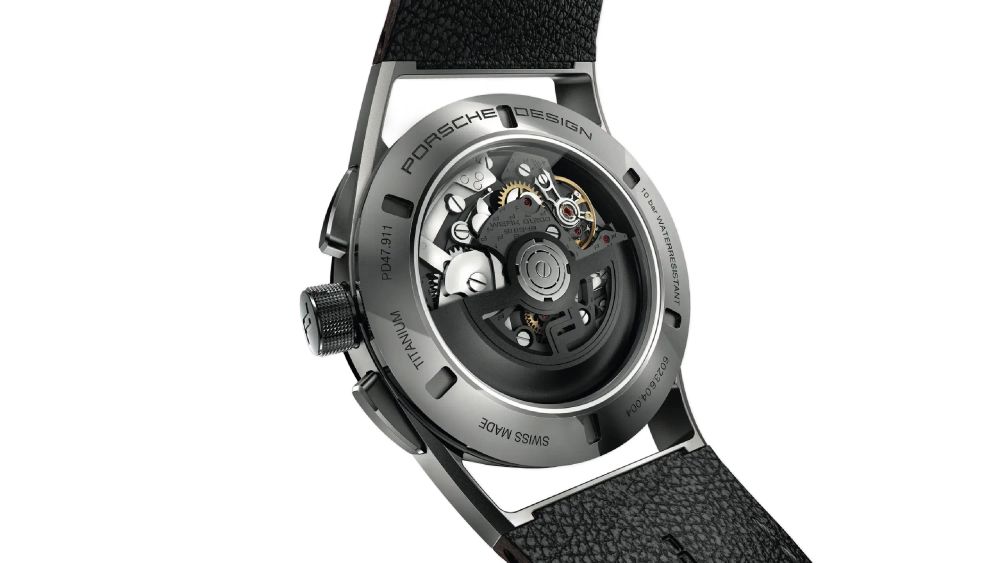
The WERK movements represent a highly pragmatic and sophisticated blend of proprietary engineering and strategic Swiss partnerships. While Porsche Design Timepieces proudly refers to these calibers as “in-house” under the WERK banner, they are developed in close collaboration with the highly respected specialist movement manufacturer Concepto. A close examination of the architecture of calibers like the WERK 01.140 and WERK 01.240 reveals a strong structural lineage to the legendary Valjoux 7750—a profoundly fitting homage considering the original 1972 Chronograph 1 was powered by the 7750. The presence of a concentric screw regulator arm over the balance bridge acts as a distinctive signature of Concepto’s high-grade design influence.
Regardless of their foundational architecture, the WERK calibers are extensively modified, proprietary solely to Porsche Design Timepieces, and engineered to superlative performance standards. They are universally submitted to the Contrôle Officiel Suisse des Chronomètres (COSC) for rigorous chronometer certification, ensuring extreme accuracy across various temperatures and physical positions.
The return to Grenchen (2026)
The search for a manufactory building began in 2020, as it became clear that the production capacity of the former manufactory in Solothurn would no longer suffice. After a thorough evaluation of numerous buildings the decision was made to acquire the former home of Eterna, being the very factory where the watches had been manufactured between 1995 and 2014.
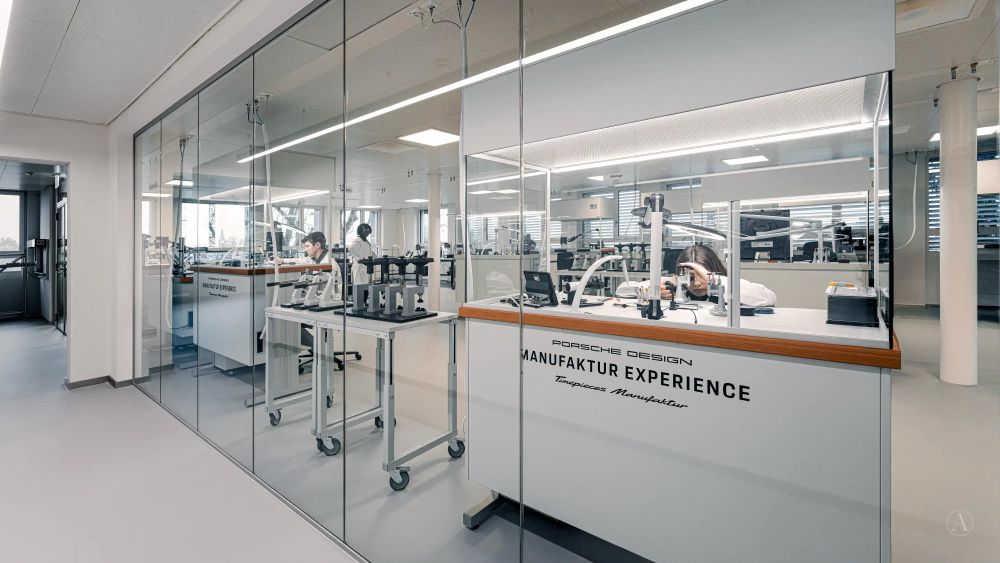
This decision appears to have been both for practical and historic reasons:
“We evaluated numerous potential locations. Our guiding principle was to carry forward the philosophy of Ferry Porsche – after all, the manufactory is only the third in-house production site of Porsche. In doing so, we applied the same precision and care as we do with our timepieces, creating the specific conditions necessary for our manufacturing,” says Rolf Bergmann.
The decision to establish a dedicated manufactory reflects the brand’s determination to realise not only the highest standards but also the brands unique attitude to customisation. Within the watch world obtaining a “pièce unique” from the manufacturer is typically something of a rarity. In 2020 Porsche Design Timepieces decided to innovate on the formula and bring their web-based car customisation technology to the world of horology.
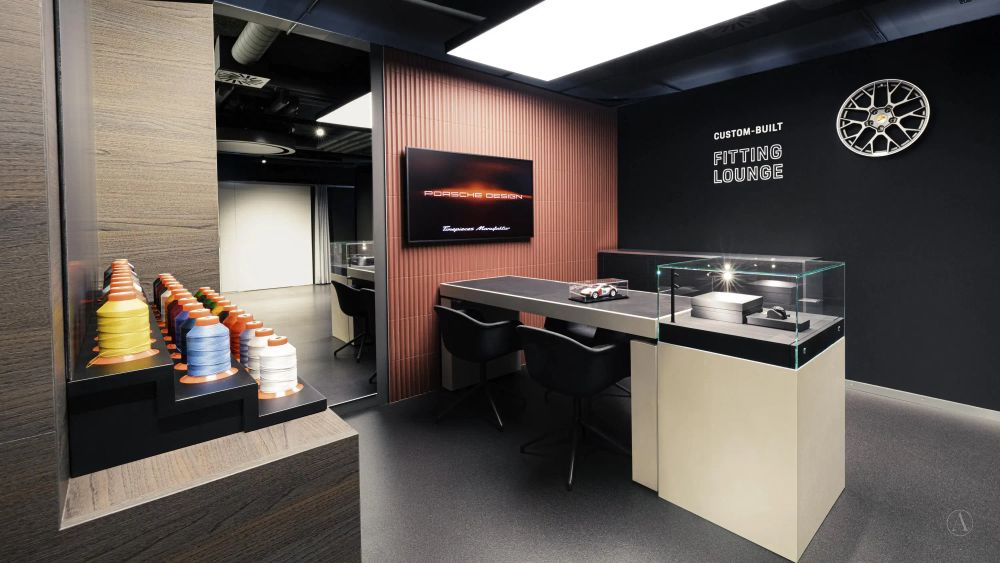
Customisation benefits existing collectors who want the ability to create something unique but also it attracts car collectors who often want more creative freedom within their collection; plus the ability to match paint colours between cars and watches will be a desirable touch to those fortunate enough to own both.
It is a Maison that it sometimes overlooked, however Porsche Design Timepieces clearly show a serious dedication to horology; they are a rare example of a “car watch” sub-division that successfully outgrew its parent brand’s shadow to become a legitimate horological heavyweight. Opening this new dedicated manufacture in the former site of Eterna shows serious investment in the past and future of their watchmaking brand.
| Photography: | Provided by Dr. Ing. h.c. F. Porsche AG for the purposes of writing this story. |
| Ethics: | No brand affiliation and this is not a sponsored article. Opinions are our own. |
